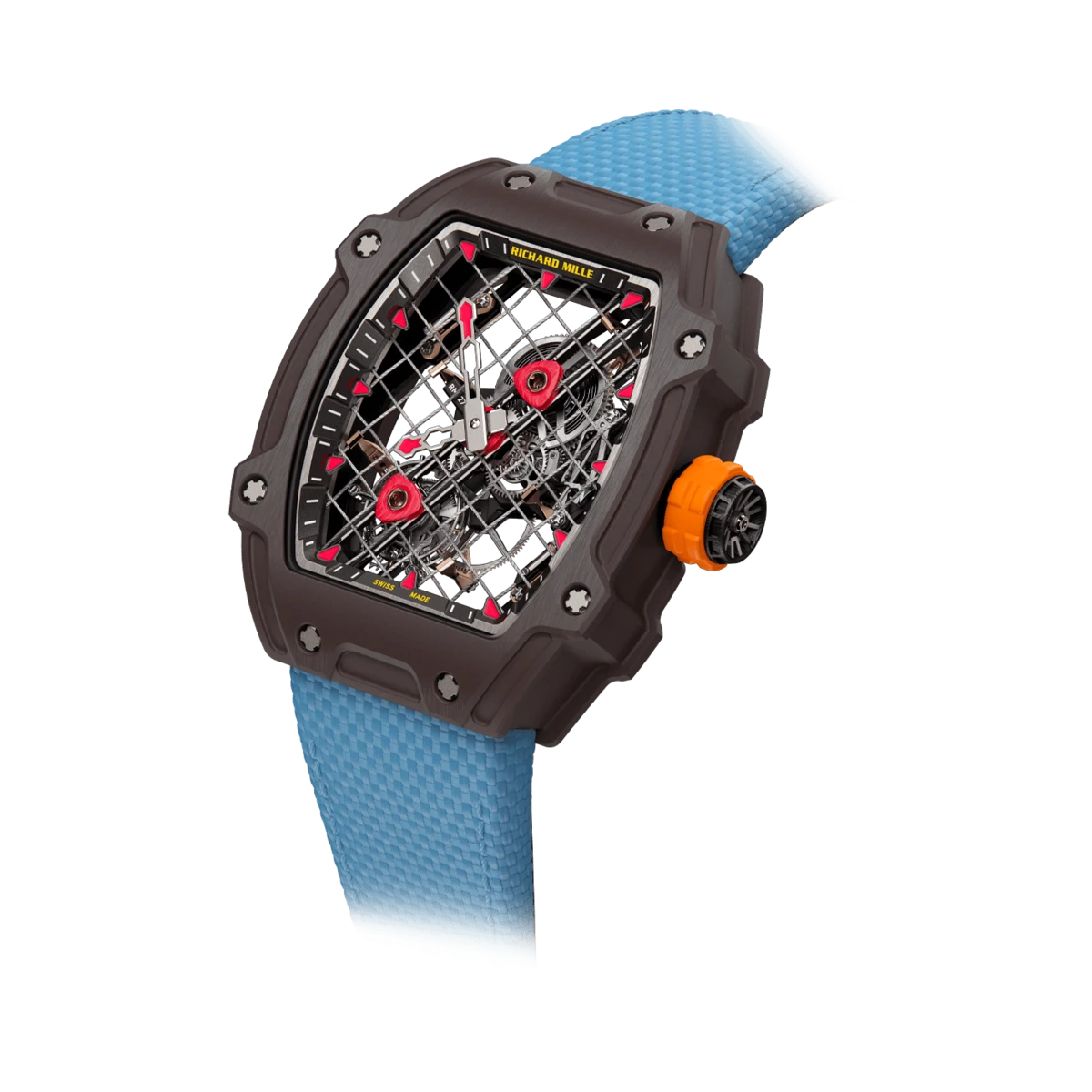
The RM 027 began in 2010 with a difficult brief: make a tourbillon light and shock-resistant enough for Rafael Nadal to wear in elite competition. Tourbillons had traditionally been delicate demonstrations of finishing; Richard Mille treated the mechanism as sports equipment. The first RM 027 used titanium and LITAL® alloy to reduce mass, and Nadal wore it through the violent acceleration, impact and clay dust of professional tennis.
Each sequel changed the architecture rather than merely the colour. The RM 27-01 suspended its movement from braided steel cables. The RM 27-02 combined the baseplate and caseband into a unibody structure in Quartz TPT. The RM 27-03 raised tested shock resistance to 10,000 g, while the RM 27-04 wove a single 0.27 mm steel cable through the case like a tennis racquet and suspended the calibre from that mesh. Limited to fifty pieces, it weighed 30 grams including its strap and withstood accelerations beyond 12,000 g in testing.
The RM 27-05 continued the experiment with a flying tourbillon and another step in weight and resistance. Across the series, production is tiny and condition assessment is unusually material-specific: Carbon or Quartz TPT edges, spline screws, strap attachment, crown, cable or unibody structure and tourbillon performance all need expert review. Provenance matters because the differences between generations are structural, not cosmetic.