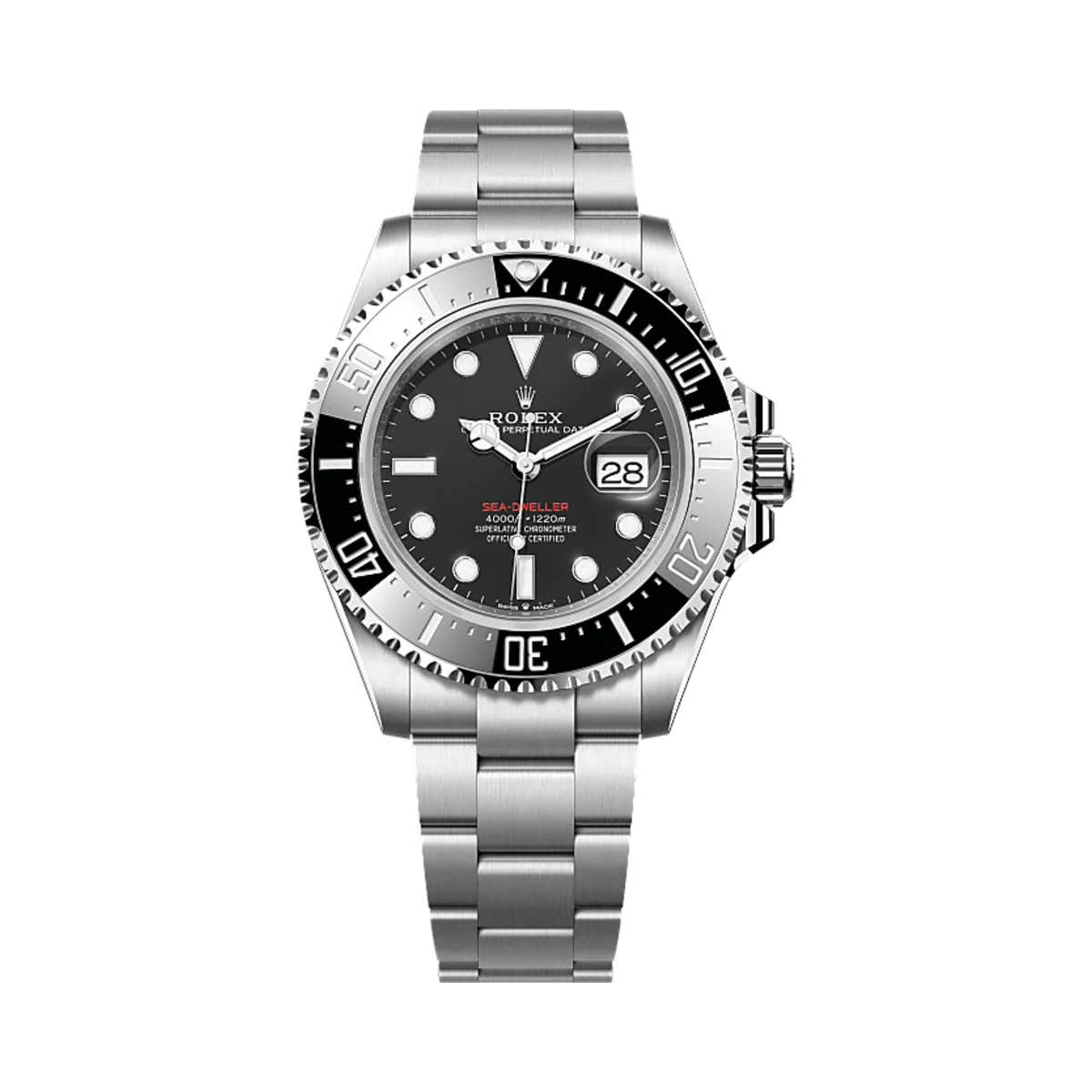
Rolex introduced the Sea-Dweller in 1967 for professional saturation diving. Divers living for long periods in pressurised habitats breathe gas mixtures containing helium; the tiny molecules can enter a watch and build pressure during decompression. Rolex's automatic helium escape valve releases that pressure before it can damage the crystal or case seals. Early development was closely connected to professional diving organisations including Comex.
Reference 1665 established the model with a date, no Cyclops lens and two red lines of Sea-Dweller text on early dials. Later all-white versions became known as Great Whites. The 16660, or Triple Six, introduced sapphire crystal, a unidirectional bezel and a depth rating of 1,220 metres. Reference 16600 refined that formula and remained in production for roughly two decades, becoming the most familiar pre-ceramic Sea-Dweller.
After a pause, the 40 mm ceramic-bezel 116600 returned in 2014 but lasted only until 2017. The 50th-anniversary 126600 enlarged the case to 43 mm, restored a red Sea-Dweller signature and, controversially for purists, added a Cyclops over the date. It uses caliber 3235 and a Glidelock-equipped Oyster bracelet. Vintage valves, dial print, bezel inserts and case thickness require specialist evaluation; on modern pieces, pressure testing and clasp condition are as important as rate performance.
