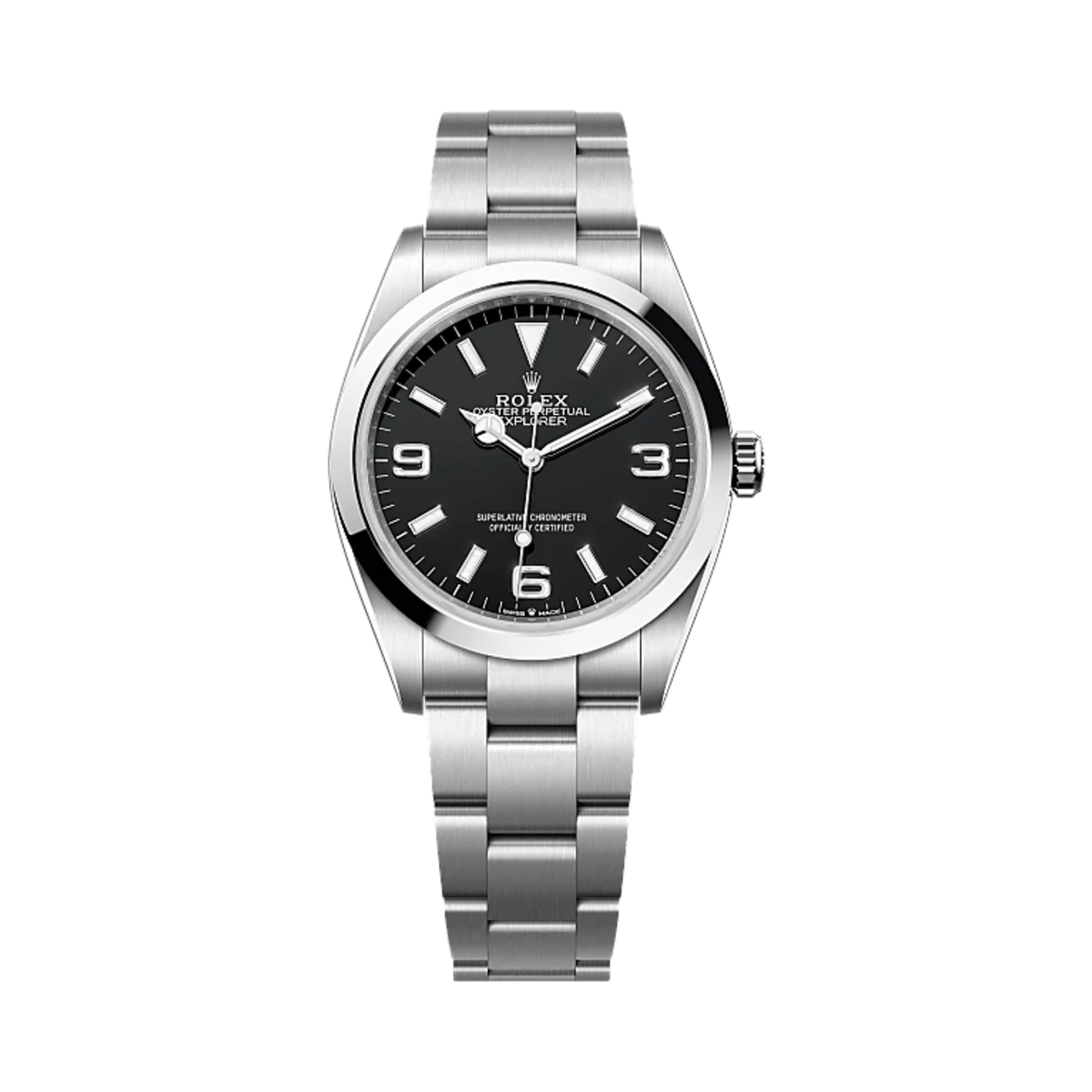
Rolex created the Explorer in 1953 in the wake of the first confirmed ascent of Mount Everest. Oyster Perpetual watches had accompanied Himalayan expeditions during the preceding years, giving Rolex a real-world programme for testing cases, lubricants and rate performance in cold and altitude. The production Explorer distilled that work into an unusually direct tool watch: a black dial, luminous hands and the now-famous Arabic 3, 6 and 9 numerals.
Reference 6350 first carried the Explorer name, followed by the slimmer 6610. The reference 1016 arrived in 1959 and remained in production for roughly three decades, making it one of Rolex's longest-lived sports references. Its acrylic crystal, restrained 36 mm case and evolving gilt, matte and luminous dials define the vintage market. Reference 14270 brought sapphire crystal and applied white-gold numerals in 1989; the 114270 continued the modern 36 mm format with caliber 3130.
Rolex enlarged the Explorer to 39 mm with the 214270 in 2010, then returned to 36 mm with the 124270 in 2021 before adding the 40 mm 224270. The current watches use caliber 3230 and retain the no-date clarity that separates the Explorer from more complicated Professional models. When comparing pre-owned pieces, dial generation, luminous material, polished case geometry, bracelet reference and movement service are central; on vintage 1016 examples, small dial differences can dominate value.
