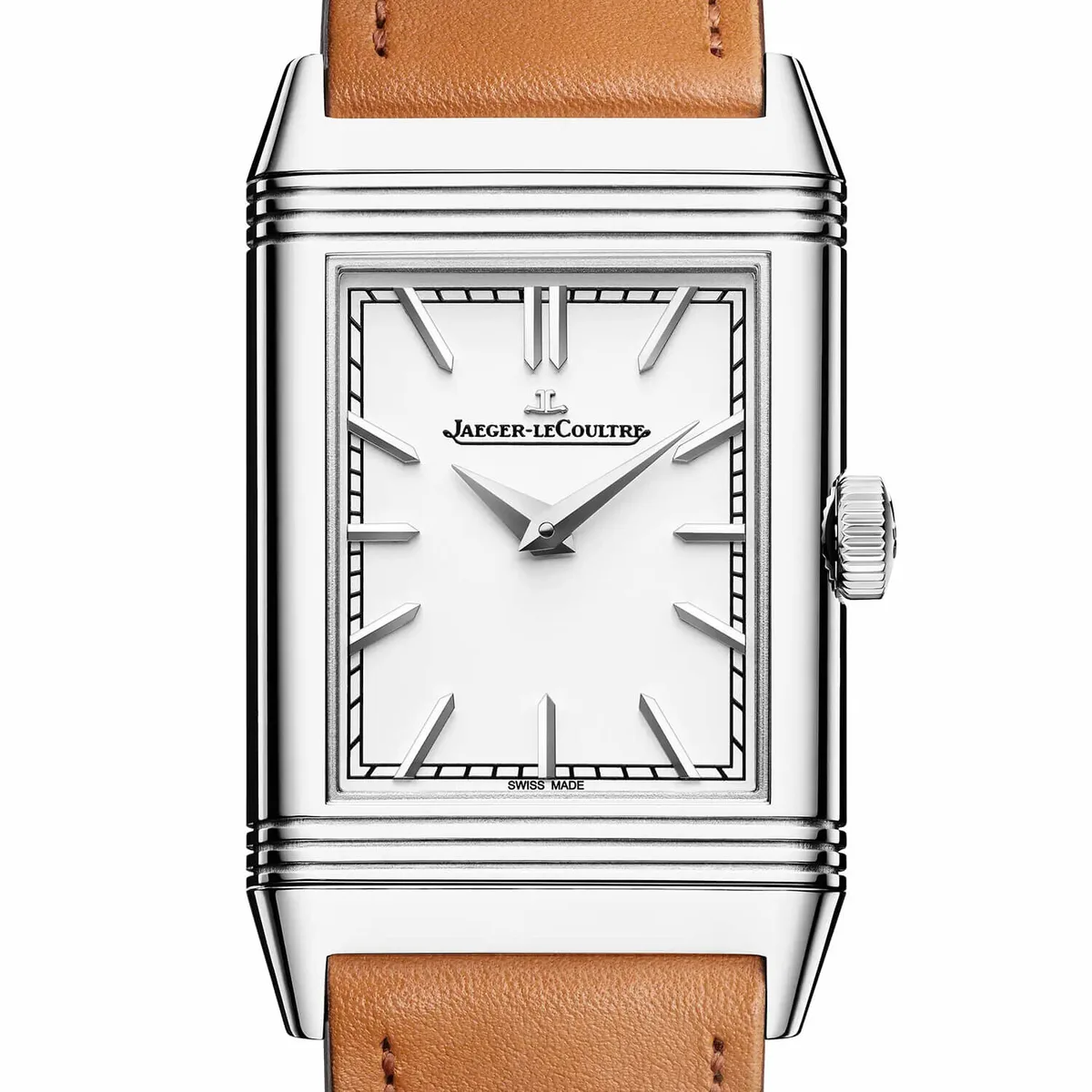
The Jaeger-LeCoultre Reverso was born in 1931 from a problem on the polo fields of British colonial India. The Swiss businessman César de Trey, travelling there, was challenged by army officers who kept shattering their watch crystals during matches to create a timepiece that could survive the game. Back in Switzerland he brought the idea to Jacques-David LeCoultre, who supplied the movements, while the firm Jaeger S.A. commissioned the French engineer René-Alfred Chauvot to solve the case. On 4 March 1931 Chauvot patented a watch capable of sliding in its support and being completely turned over: a case that flips on its cradle to hide the dial and crystal behind a solid metal back. The Reverso name, Latin for "I turn," was registered in November that year, and first deliveries followed before the year was out.
The original case measured 38 x 24 x 6mm and was pure Art Deco, with three signature gadroons top and bottom, sword hands, dart indexes and Arabic numerals, built from just 23 parts. Through the 1930s the reversible case was so admired that Patek Philippe, Vacheron Constantin and Cartier briefly used it too, and in 1937 Jaeger and LeCoultre formally merged into Jaeger-LeCoultre. The blank caseback also became a canvas for enamel, engraving and miniature painting, a tradition the Maison still maintains.
The Reverso fell out of fashion after the war and effectively ceased production around 1948. Its revival came by chance: in 1972 the Italian agent Giorgio Corvo discovered roughly 200 forgotten steel cases at the manufacture, had them fitted with movements and sold them all within months. That success convinced Jaeger-LeCoultre to relaunch the line, and engineer Daniel Wild reverse-engineered and modernised the case, which by 1985 was machined in-house, water resistant and built from dozens of components rather than the original 23.
From that base the Reverso grew into a true platform. In 1994 the Duoface appeared, using Calibre 854 to drive two dials back-to-back, the front showing local time and the reverse a second time zone with day/night indication. The reverse face has since hosted tourbillons, minute repeaters, calendars and the Gyrotourbillon. Today the collection spans the Classic, Tribute and feminine One lines, plus haute-horlogerie editions. Collectors prize the Reverso for its instantly recognisable rectangular silhouette, its hand-wound movements, its engravable caseback and its unbroken story since 1931.
Bedesten Watches has sold authentic Jaeger-LeCoultre watches in Istanbul since 1999. At our Suadiye showroom in Kadıköy we offer a rotating selection of pre-owned Reverso references across the Classic, Tribute and Duoface families. Visit us in Suadiye or message us on WhatsApp +90 532 327 88 26 for current stock and pricing.
